 Facing pounding rain as I headed out to see advantage Lucy and others, I remembered a line from the Lucy song “Smile Again”: “I realized there's no rain that never stops (yamanai ame nante nai to kizuita)”. And, indeed, by the end of the Basement Bar show, the downpour had run its course.
***
There were many friends at the Basement Bar. Watching the show next to the stage was Three Berry Icecream's Mayumi, whose music advantage Lucy grew up listening to. Mayumi's daughter was also there—she's known these bands since she was a baby. But where once she danced and called out the names of favorite singers, now, in elementary school, she ducked behind the stage and plugged her ears during the loud parts. The evening's headliner, Murmur's Mai Tsuyutani, was an advantage Lucy fan from when she was a teen-ager. She was too shy back then to say hi to the band and tell them she's learning to play the guitar; hearing that, Lucy guitarist Ishizaka gave Mai's mom (who had taken her to the show) a guitar pick to pass on to her daughter as a souvenir. Mai says she still has it, in her little treasure box at home.
Lost In Found, the first act, toured Seoul together with advantage Lucy in 2004. They were always good, in a cute amateurish way, but in a few years' time they've developed into great, fun live band, at once relaxed and energetic, and featuring one of the prettiest-sounding guy-girl vocal duos around. They've become a band I want to see every time they play. Act two was Caraway (the top photo), Swinging Popsicle guitarist Osamu Shimada's other band. Swinging Popsicle and advantage Lucy both hit it big in the late-90's, and they considered each other as rivals of sorts back then, in a good way, but now, a decade later, they are good friends. Swinging Popsicle's vocalist's husband runs the Nakano pasta joint where advantage Lucy filmed their “Sunday Pasta” video. (By the way, my friend David Cirone has published a photo collection of Swinging Popsicle. It's full of gorgeous pictures of the bands, plus two interviews, one by me. If you're a Popsicle fan, check it out! Info here.)
***
Outside the club before the show, a mikoshi, a portable Shinto shrine, was being carried around, bounced up and down, when a fight broke out. One of the fighters was a guy in dreadlocks; his challenger grabbed his dreads, and he latched on to the challenger's hair too, so the mediators found it impossible to pull them apart, and all the revelers stood and watched the the spat in silent disgust. It must have been all the drinking that prompted the fight—fights happen from time to time at festivals, where adults often drink continuously from the early afternoon. The crowd was unhappy the festivities were sullied by a fight. But, I couldn't help thinking that maybe one thing being celebrated at a matsuri like this was the elemental nature of humans, not only love and fertility, but also fighting and destruction, so the spat wasn't completely out of place...
Rabu, 10 Juni 2009
Murmur, advantage Lucy, Caraway, Lost In Found

Nikko; Bug Noises; The Divine Warlord
 Do the Japanese have a unique ability to enjoy the singing of autumn insects? It's something people say around this time of the year. I have no idea whether it's true—I'm a connoisseur of these evening insect sounds, but then again I've been in Japan for so many years that I'm definitely 'turning Japanese', and have no idea whether that's normal...But really, I do think there's something haunting and musical about the repeated calls of bell crickets and other insects in autumn nights. As Madame Sei Shonagon said, the evenings are the best part of autumn.

***
I got to thinking about bug noises during a trip to Nikko, where I stayed at an inn that had an outdoor hot spring bath which, in the silence of the night, became something like a concert hall for crickets.
Despite my more than a dozen years in Japan it was my first time in Nikko, in one of those, 'I live in Paris but have never been to the Eiffel Tower', or 'LA's my home but I've never been near the Hollywood Walk of Fame' deals, where a place is such an obvious destination to visit that you assume you will make it there eventually but don't.
In any case, Nikko is famous for the Toshogu, the shrine for Tokugawa Ieyasu, the founder of the Tokugawa shogunate. It's a gaudily-decorated, gold-filled building complex, quite unlike the 'wabi sabi' understatement of other major Japanese shrines and temples. At the local bookstore I picked up a book called “The Mystery Of Toshogu” which I read in my free time, and it had some fascinating explanations and theories about the shrine.
One of those was the issue of why Tokugawa Ieyasu, a warlord, was able to be made a 'god' by his descendants and to be enshrined in Nikko. The book said that in Japanese history, it wasn't unusual for someone with exceptional ability to be venerated as a divine being after his death; even the Shinto gods were thought to have started out as humans. One problem is that the word 'god' may be a somewhat misleading way to translate the Japanese term 'kami'—the Japanese word has more the sense of an extraordinary natural phenomenon, rather than an all-powerful creator of the world (and, in fact, big natural things, like mountains, have been worshiped in Japan as 'gods').
Tokugawa, as someone who was able to bring to an end the warring states period (even if on the coattails of his predecessors Oda Nobunaga and Toyotomi Hideyoshi) and launch an enduring era of peace, was worthy of becoming a god. In fact, he actually put it in his will that he wanted to receive that divine status, choosing to stay in this world, in Nikko, to make sure everything's going fine, rather than taking it easy in the Pure Land Paradise. Which, to the modern reader, seems like quite picky and ambitious directions on how to spend the afterlife...
At Toshogu, there are many sculptures that symbolize the peace that Ieyasu brought about. There are sculptures of the kirin, pictured on the label of the beer of that name, a hooved mythical creature that only appears when a sage is ruling and hides away when a tyrant is on the throne. There's also the baku, a creature with an elephant-like trunk; it eats nightmares, so samurai lords had it illustrated on pillows. It also eats iron, and when there's war and the metal is taken away to make weapons, it goes hungry. It too is, therefore, a symbol of peace. The Youmei gate in Toshogu has sculptures, in addition, showing scenes of children playing—something they could only do in peaceful times.
The book also talks about why Nikko was chosen as the site of Ieyasu's main shrine. To simplify the argument, one significance of Nikko is that it's directly north of Tokyo, the home of the Tokugawa shogun. A northern position was where the protector of people traditionally resided—ancient Chinese and Japanese palaces were on the northern end of towns. A ruler in the north has his back to the northern pole star, which hardly moves in the sky, and lends to him its unmoving stability. In any case, by being enshrined north of Tokyo in Nikko, Ieyasu would be able to look over his descendants as a divide protector.
Ieyasu was actually buried at first in Kunouzan in present-day Shizuoka prefecture, before his remains were moved to Nikko, in line with his will. The book says this is noteworthy because on the diagonal line between Kunouzan and Nikko is Mount Fuji, and 'Fuji' is similar in sound to the Japanese word for 'undying', 'fushi'—the path between Kunouzan and Nikko may have symbolized the passage of Ieyasu from living to divine status. Kunouzan, for its part, might have been chosen because directly west of it (following the path of the sun, an important object of worship in Shinto) is Ieyasu's birthplace, and going further, Kyoto.
Who knows whether this stuff is on the mark, but it's interesting to think about it while seeing the sights of Nikko.

Senin, 08 Juni 2009
Japan Live TOKYO LIVE HOUSE GUIDE
You're going to a music show in Tokyo. You wonder what the venue is like. You've come to the right place.
This post is about Tokyo's music clubs, which are called live houses. There's an incredible number of them—everything from huge venues that house thousands of people, to two speaker holes-in-the-wall. They are mainly located in the big shopping districts—Shibuya, Shinjuku and Shimokitazawa—but some are in quieter areas too. This post lists the main live houses, and the interesting smaller clubs and cafes. It's not a complete listing; some places I've neglected to mention because I forgot to, or didn't know the place, or didn't like it. Let me know if you think I should add any clubs.
NOTE: Directions to these clubs can be found in Tokyo Gig Guide. Tokyo Damage Report also has a list of punk clubs and other weird venues. I also wrote in the past about how to go to these clubs.
SHIBUYA
O-Nest: The O-Nest is probably Tokyo's most exciting live house now. It's a small venue that attracts artists that are innovative and accessible but haven't hit the big time yet (Spangle call Lilli line would be one example). O-Nest is also well designed: it has separate stage and bar floors connected by a stairwell overlooking Shibuya's love hotels, and it's one of the few live houses that lets you leave the club and re-enter it later. But though it's a good club I've found one strange thing about the O-Nest, which is it seems to have a high incidence of shows that look good on paper that end up being duds. I've probably left in the middle of more gigs here than anywhere else. Maybe that's a result of their hosting many new bands whose skills haven't caught up to their novelty and the hype surrounding them.
Quattro: I dislike the Quattro. But I have to go there once in a while because some musicians only play there. It's a Soulless Corporate Live House (SCLH). The sound and light systems are outstanding. But everything else is mediocre: the venue has no atmosphere; the staff are apathetic or worse; and the 'one drink' that you have to pay 500 yen for is about the size of free booze samples they hand out in department stores.
La Mama: I've only been here once or twice, but it's a decent live house with an easy-to-see, wide stage.
Eggman: Similar to La Mama. It's one of Shibuya's older live houses, and I think it's seen better days.
O-East & O-West: Sister live houses of the O-Nest, these two are for bigger acts, and they're both Soulless Corporate Live Houses (SCLH's), like the Quattro.
O-Crest: Size-wise it's between O-Nest and the two big O's, it's also basically a mini-SCLH.
Ax Shibuya: One of Tokyo's biggest live houses, it's a SCLH. But you gotta go there to see acts like Perfume.
Deseo: Next to the Yamanote train tracks, this is a live house for bands that are starting out. It's a Dive House—a live house that's a dive.
Yaneura Shibuya: This place has been around for ages, and it's the definition of a Dive House: witness within its walls the unending struggle between unruly, inebriated youth and surly staff.
Cyclone: Sister live house of Yaneura, it's also a true Dive House. My friend Dr. I once said this is a club for juvenile delinquents.
Chelsea Hotel: A relatively new live house, it looks like a lobby of a cheap hotel(in line with its name?), and attracts decent bands.
Aoiheya (blue room): This is a fun live house run by a chanson singer, and is designed according to her tastes (vines handing from the live stage ceiling, etc.).
Lush: A very hard to find live house, Lush hosts decent bands.
Tube: In a small alley near Tower Records, this a small but pleasant and well-designed space.
SHIMOKITAZAWA
Que: Sometimes called one of the three great live houses of Shimokitazawa, along with the Shelter and Club 251, the Que is THE club for guitar pop, power pop and all manners of melodic, not-so-hard rock. It's the home turf of groups like advantage Lucy. The Que is also one of the few smaller live houses that don't force ticket sale quotas upon performers, and its events are generally of high quality. In spite of its prestige, though, the club is small, with only one main room, and can get very cramped at sold-out shows.
Shelter: Just down the street from the Que, the Shelter is the place for hard rock and smarter punk. It's a Dive Bar, but in a good way—they host rockin' bands, and the fans are into the shows.
Club 251: About midway in musical taste between the Que and Shelter. It's probably also fair to say that of the top-3 Shimokitazawa live houses, it's number three.
440: Right above 251, and run by the same people, this is a cafe club with chairs for the audience. The acts are generally mellow, with a lot of acoustic sets, and post-Shibuya-kei groups often play here. If watching a show here, make sure you aren't late, because then you will have to stand and there isn't that much space...
Basement Bar: This club is nearly impossible to find, hidden behind the beer cartons of a liquor store off of the main Shimokitazawa drag. It's a small live house that hosts decent events.
Mosaic: A fairly new live house, Mosaic is good because it has a bar on one floor and the live stage under it, letting you escape for a drink if an act is bad.
Mona Records: Like 440, this is a cafe club, but one with more character: the space is designed to look like a living room, and the area where musicians play is a raised floor where audience members take off their shoes and sit on the floor like in a traditional Japanese home (even the musicians play shoeless!). The bands featured at this club are pop, jazz, acoustic and mellow, mellow, mellow. Mona Records also sells CDs, has its own small label, and hosts small art exhibits—it's one of the more interesting clubs in Tokyo.
Garage: On the other side of the tracks from the Shimokitazawa Big-3, the Garage seems to mainly feature genki, straightforward youth rock groups. It's a small venue, and being right in the middle of a true residential area, the staff will, with fervor, chase you away from the premises as soon as shows end.
SHINJUKU
Loft: The Loft isn't Tokyo's biggest live house, but it is certainly its most legend-filled: having opened in 1976, the club has over the years featured some of Japan's most popular acts such as Southern All Stars, Boowy and Judy and Mary. The events held here are still of generally high quality. The Loft moved to Kabukicho from Nishi-Shinjuku in 1999—the live house now is a comfortable space with separate stage and bar floors, but be sure you don't get lost in the building that houses the Loft, because most of the other establishments in the building look pretty questionable...
Marz/Motion/Marble: All on the same block near the Loft, these three live houses are run by the same people, and sometimes events are held at a number of these clubs at once, letting you go from one to the other (and allowing you to get food and cheaper drinks at convenience stores en route, if you desire). Marz is a sparkling new club with a fancy light system. Motion is a small live house suited for minor indie bands. Marble, I haven't been to.
Jam: Shinjuku Jam is another of the older Shinjuku live houses, but, while its rival, the Loft, has turned into a Big Deal, the Jam remains a Dive House, a live house that is also a dive. Still, some people like the Jam for that, and it certainly has character. I've heard that the Jam is haunted.
Red Cloth: A fairly new live house, the Red Cloth is an attractive, small venue that's decorated in a vaguely Chinese fashion. From my experience the staff is generally friendly, and the indie events held here are often good.
ACB Hall: A total dive house, for punk kids.
YOYOGI
Zher The Zoo: Run by the same people as the Que in Shimokitazawa, Zher The Zoo features bands that are very similar to those at the Que (Luminous Orange played here, for example). And no, I don't know what the name means.
KOENJI
Club Liner: Managed by a member of the comic punk group Telstar, Club Liner is a small club that brings in a lot of decent indie groups, many of them probably the Telstar guy's pals. Club Liner is also one of the first live houses, as far as I know, that divided its space into smoking and non-smoking sections (cigarette-smelling clothes and stinging eyes are constant occupational hazards for Tokyo club-goers).
Club Roots: This is a tiny club in an interesting building with an Okinawan theme, including an Okinawan restaurant and a culture center. Roots also serves awamori and a limited number of Okinawan fast food.
20000V: This is a Dive House (a live house that's also a dive), but one of those that's hard to dislike if you have a taste for dives.
Los Angeles Club: Went here a long time ago, don't remember what it's like, but am pretty sure it was a Dive House.
Enban: This is supposed to be a record store/cafe, but it's not clear whether it actually exists. I once passed by the place it's supposed to be, but didn't see anything except a window, from which some sketchy looking characters stared down at me. It could be that the Koenji guys are just putting me on, and this club is fictional—you have to watch out for Koenji people...they are sometimes of somewhat suspicious character...
SANGENJYAYA
Heaven's Door: In the middle of a peaceful local shopping district with little stores and eateries is this home of tattooed, body-pierced head-bangers and punkers of all stripes. Heaven's Door is the epitome of a Dive House (a live house that's also a dive), but one that you are sort of glad exists, in the same way that you appreciate there being brutal carnivores in the great outdoors, in addition to gentle creatures such as sheep, deer, zebras, etc.
Grapefruit Moon: If you're headed to this lovely cafe and are starting to worry whether the directions are wrong—could a music club really be in a little street like this with vegetable and fruit shops and fish sellers?—don't fret, and keep on going, because you're almost there. Right next to a bathhouse, Grapefruit Moon often features laid-back indie pop bands.
AKIHABARA
Goodman: Goodman is the place to go for prog, post-punk, smart indie-type bands. There seems to be a lot of affinity between the Goodman crowd and Koenji folks—maybe because it's connected by the Sobu line?
KICHIJOJI
Star Pine's Cafe: Not much to say about Star Pine's Cafe except that it's a nice-looking, two-storied club.
Mandala 2: A cafe bar that's pretty characterless. Good indie bands sometimes play here, however.
DAIKANYAMA
Unit: I've never been here, and hope I don't ever have to, because the place exudes bad vibes: unsmiling staff who appear authoritarian in the way they make show-goers line up before shows, and so on. It's too bad because this club attracts a lot of fashionable, post-Shibuya-kei-type groups that look interesting. I imagine that the Unit is basically a SCLH (Soulless Corporate Live House).
HARAJUKU
Astro Hall: Not a big fan of this place...not sure what the management here wants to accomplish except to squeeze money out of young people there to see trendy bands. It's a mini-SCLH (Soulless Corporate Live House).
EBISU
Liquid Room: This big club used to be in Shinjuku in a scary building whose floor would bounce up and down with the crowd as they bopped to the music...The Liquid Room is now in a bright and shiny new building near the station, but it's a true SCLH (Soulless Corporate Live House)—I once saw a security guard stop someone from passing out live show fliers TWO BLOCKS from the club, after a show. What sort of authoritarianism IS that?? Still, a visit to the Liquid Room is inevitable once in a while, because they host a lot of great Japanese and foreign artists...
Guilty: I went here ages ago to see Fugazi, and don't remember a thing about it. A big regret in my life is that I saw Joe Lally at the Freshness Burger near the Guilty but didn't say hi to him.
So You Want To Be A Rock 'n' Roll Star (In Japan)?
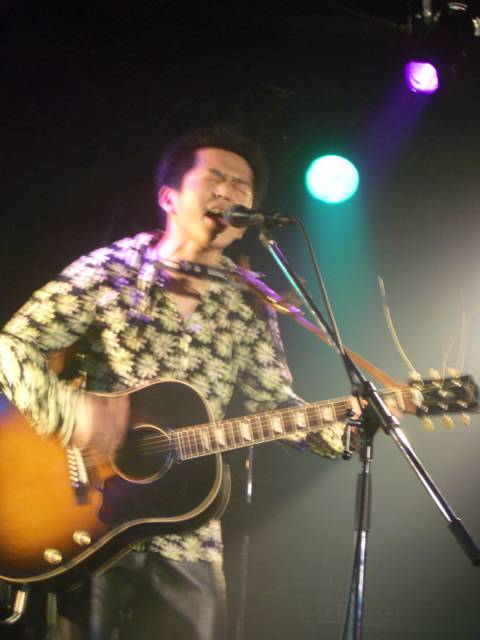
So you want to be a rock 'n' roll star? 
Since I started this blog half a year ago, the most frequently asked question from e-mailers, in fact the ONLY frequently asked question, is from musicians outside of Japan wondering how to go about arranging a show in Tokyo or the other big cities.
Now I’m not a band member myself so I’m not the right person to answer this question, but I do feel sympathy for these e-mailers. I too, if were a musician, would be interested in playing in Tokyo, which is more and more becoming one of the world’s Pop Culture Capitals.
Unfortunately, the short answer to ‘How can my band book a show in Japan?’ is, ‘not easily’.
I sought the opinion of Edgar Franz, who leads a band called Miniskirt in Tokyo and has done numerous shows, including at Shimokitazawa’s Club Que, a highly regarded venue.
"I guess that it's nearly impossible to handle show bookings from outside Japan," he said.
It also doesn't make much sense. You need Japanese support acts and someone on location to do the promotion anyway. The managers of the live venues usually want to talk personally to the organizers. Demo tapes and resumes of the bands have to be transmitted. As there are hundreds of bands playing every night, it's very hard to attract visitors. Just 80 visitors is already a success for an event with 4 indie-bands playing.

Edgar Franz of Miniskirt.
What Edgar is talking about in regard to the club managers is that, like Japanese businessmen in general, the managers are somewhere between being perfectionists and obsessive-compulsives. Just as Japanese salary men are notorious for holding endless meetings that don’t do much to boost productivity, club managers here have a reputation for wanting to know everything about a show before it happens (resumes, personal interviews, required rehearsals the day of the show), which might not necessarily be that helpful in sparking a spontaneous rock ‘n’ roll explosion.
So, the perfectionist club owner won’t be too inclined to book a band from thousands of miles away based only on a demo tape and a few e-mails (especially if those e-mails aren’t in Japanese!). Edgar adds that even a fairly well-known foreign band wouldn’t be able to book a show in Japan without a local coordinator.
Nothing is for certain, though, and if a band were to come to Japan for a couple of weeks and made the rounds of clubs, bars and cafes in one of the big music centers like Shimokitazawa, they might very well get a lucky break. But the band members should keep a sense of perspective, and enjoy the visit (and they should watch as many shows as they have time for and can afford, because Japanese bands are world-class).
One last thing, and I realize this isn’t feasible for most band guys, but if you really want to perform in Japan, nothing would beat actually living here, at least temporarily. Teach English, work in a bar, or do whatever work you can find, and in your free time try to break into the scene. If you start getting action, and you have time to blog about the in-depth experience in the Japan music scene, I will certainly read YOUR Japan Live!
How To Go To A Tokyo Rock Show
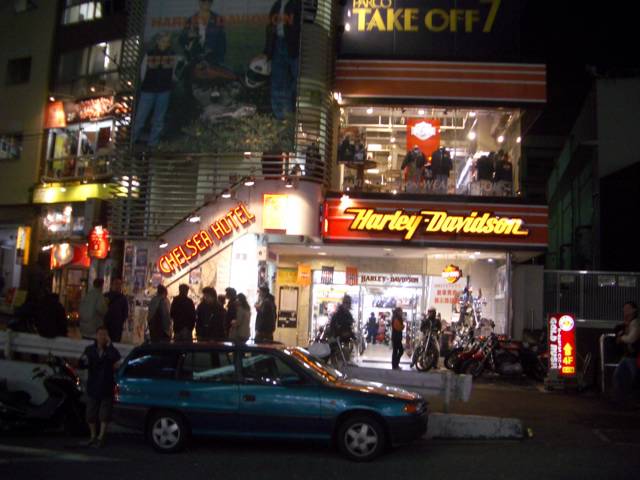
Shibuya clubs Chelsea Hotel and Take Off 7.
You’re coming to Tokyo on vacation. During the day you will go to the Imperial Palace, see a piece of traditional Japan in Asakusa, take a trip to Kamakura to visit ancient temples. But at night you want to unwind and have fun. How about catching a rock show?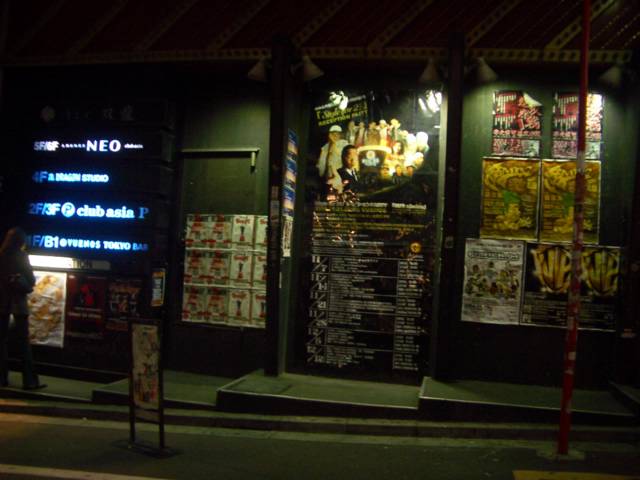
Posters for events in Shibuya.
On any night, there are dozens of clubs where Japanese rock bands are playing. The best clubs, or ‘live houses’ as they are called here, are concentrated in the western side of the Yamanote train line, which circles central Tokyo. Shinjuku, Shibuya, Shimokitazawa and Ikebukuro are where the finest live houses are. Each of those areas has its own character, its strong and weak points.
SHINJUKU
Advantage: Home of the Loft, one of Japan’s most famous and oldest rock clubs, Shinjuku live houses feature some of Tokyo’s best bands. There are lots of punk shows.
Disadvantage: Most Shinjuku live houses are in Kabukichou, Tokyo’s premier red-light district. Expect to dodge touts for various adult entertainment to get to shows. It’s like walking through a brothel for some rock ‘n’ roll. (This might not be a weak point for some readers, to be sure.)
SHIBUYA
Advantage: There are great shopping and record stores in the area (including the Grand Temple of Japanese music, the seven-floor Tower Records Shibuya).
Disadvantage: The live houses don’t have much character.
SHIMOKITAZAWA
Advantage: A short train ride away from Shibuya or Shinjuku, Shimokitazawa has its own scene, and many in the audience are themselves likely to be musicians and appreciate good music. The quality of bands playing at clubs like the Que and Shelter are usually high.
Disadvantage: Sometimes the audience is nothing but musicians, making for a boring (and incestuous) crowd.
I hardly ever go to Ikebukuro, further north from these three music centers above, so I don’t have anything to say about it.
Street between O-East and O-West in Shibuya's love hotel district.
One thing about most Tokyo rock clubs is they’re hard to find. They’re in the basements or upper floors of characterless buildings. But don’t let that discourage you, because there’s an excellent on-line resource called Tokyo Gig Guide, put together by a Tokyo resident named Craig E.
Tokyo Gig Guide gives detailed instructions on how to get to the major live houses, with some photos.
Another extremely useful thing Craig does is put together a calendar of good shows. The gigs he lists are all worth watching.
Or, you can simply head to one of the clubs and take a chance on the bands playing that night.
My experience is that shows at the Que and Shelter in Shimokitazawa, and the Loft and Red Cloth in Shinjuku, usually showcase decent-to-great bands.
***
Most Tokyo rock shows start at 6:30 or 7 at night. I think this is so that the shows can end by around 10PM, allowing fans living far away to catch the train home. (Trains stop running between midnight and 1AM.)
Except for very popular acts, you usually don’t have to buy tickets in advance. Typically, tickets cost about 2,500 yen at the door, or around US$25, and you need to pay another 500 yen or so for the first drink.
If there’s more than one band playing, the ticket seller will ask you which band you’ve come to see. Even if you hadn't come for any specific band, it’s a nice thing to do to tell the ticket seller the name of any of the bands written on the program. That’s because the clubs divide up part of the revenue from the show based on which bands the ticket buyers say they have come to see. (That is, if 20% say they’re Band X fans, then Band X gets 20% of the payout.) So, if one band has a particularly crazy name that you like, or is low on the roster and probably consists of starving musicians, you’d be doing them a favor by telling the ticket guy that’s your band, even if you have no idea who they are.
Of course, if there’s only one band playing that night, you don’t need to tell the ticket seller you’ve come to see that band. If you do, the ticket seller will nod politely, wearing a serene expression, but will be thinking: "yeah, no duh."
I talk to the ticket sellers in Japanese, but they should be able to understand English, considering they must have graduated from high school and therefore studied English for six years. Ask first if the person speaks English and then talk S-L-O-W-L-Y (as rust may have set in to their English comprehension skills in the years since they last studied the language).
Shows end about 10PM. Band members often come to talk to fans on the floor when the shows are finished. If you liked a band, by all means talk to them, say you loved their music, buy their CDs and so on. Most musicians live for those kinds of encounters.
Enjoy!
Christmas is just around the corner...
The Clicks in Yokohama
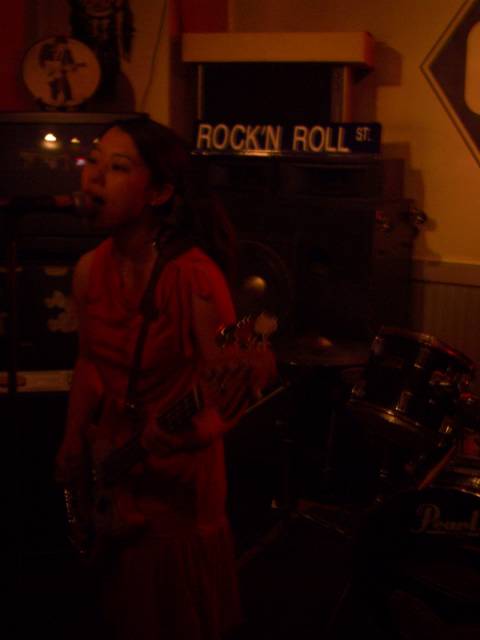
Bassist Chiharu of the Clicks.
(Sorry about the bad quality of this photo - I didn't use a flash. But I wanted to post it anyway because of the so-cool "Rock 'n' Roll Street" in the background.)
This is, unintentionally, turning into a weekend of all-girl bands.
Last night I saw the Noodles in Shimokitazawa. Today, I went to Yokohama to see a three-girl trio, the Clicks.
I first found out about the Clicks when I saw a flier for their debut album in one of those bundles of fliers they give you at the door at Japanese rock clubs. Among the colorful advertisements, the Clicks' stood out. It featured three good-looking Japanese women in cocktail dresses -- and it was clear they weren't models but the actual musicians in the band. I speed-walked to Tower Records to buy their album, Come To Vivid Girl's Room.
The music in the album was straightforward hard rock/punk. Fun to listen to, bit nothing to write home about. But on my scale of rock band ratings, all-girl bands earn an additional 50 points, while those with girls wearing colorful cocktail dresses get 50 bonus points, so the Clicks were better than perfect. They immediately became a personal hit. I especially liked the last song on their album, a love ballad called 'Summer has gone'.
The show was at the Motomachi Gig, a Yokohama bar that usually plays 60's and 70's rock but has punk rock shows on weekends. The event took place after a rare, beautiful sunny day during the June rainy season, with an approaching typhoon causing the clouds to travel fast in the blue sky.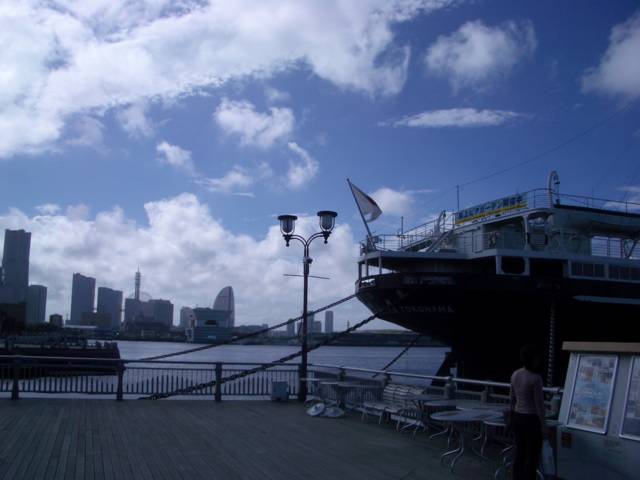
Yokohama
The Clicks were in the same primary color dresses as they wore in the photo on their album cover. Somewhat unexpectedly, though, for a band whose members look like Moody Jazz Night at a hotel bar, the girls played with plentiful rock 'n' roll spirit. The Gig was home ground for them, according to what guitarist Yuko said during the show: Their first performance after forming in 1998 was in Yokohama (I was surprised that they had been around that long).
I didn't have a chance to talk to the band members, but they're playing at the Shinjuku Red Cloth next week, so maybe then.
Drummer Yuki and guitarist Yuko of the Clicks.
Vasallo Crab 75/Noodles/Salt Water Taffy
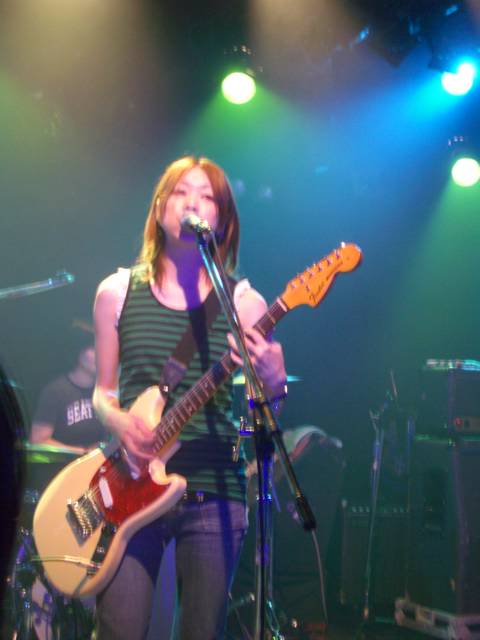
Noodles singer Yoko in her watermelon outfit.
Wow. Vasallo Crab 75. They made the rock club tonight as hot as a basement on a Tokyo summer day with the air conditioning down.
This 5-man alternative music band has topped Japanese indies charts recently, and they are creating a buzz in the Tokyo live music scene. Watching them live at Shimokizawa Club Que, it's not hard to see why.
They played for 40 minutes without stopping, creating a sound feast with musical ingredients like psychedelia, funk, pop and a bit of punk. Vasallo even puts an electrical vioin to good use -- it makes some of their melodies sound a bit like psychedelic-era Prince. (Singer Daisuke Kudo is a big Prince fan, according to the band's home page.)
Vasallo was the band Takayuki Fukumura belonged to before he passed away last year of heart disease. At one of their past shows, a band member said the truth was that even after months had passed, they hadn't gotten over his death. But at the same time, it seems the spirit of Fukumura drives the band members to make intense, beautiful music. What a band Fukumura left behind!
***
The Noodles were the first act of the evening, followed by Vasallo. It was my second time seeing the all-girl band live. The singer of Salt Water Taffy, the final act of the night, described the Noodles well: She said they are 'kawaii' -- cute -- and 'kakkoii' -- cool. A musical group of four women in Tokyo playing heavy but catchy original rock tunes is the definition of cool.
The band recently went on a U.S. tour, photos of which can be seen on their home page by clicking on the map of America on the floor. They visited McCabe's Guitar Shop in Santa Monica, California. I only mention this because the fine store is a 5-minute walk from my parent's home.
Yoko, Noodles' singer, claimed she'd forgotten about tonight's show and that's why she was wearing a T-shirt that made her look like a watermelon.
***
It was my first time to Salt Water Taffy. They were a quirky bunch -- the singer, whose name I don't know, scolded (half-jokingly, I think) the bassist for messing up a part, and she ran off stage in the middle of the set to change into a T-shirt from a tanktop that kept on trying to slip off of her. But they played good hard rocking music.


 Postingan


